
Universality Through Structure
Introduction
One of the central claims of the Universal Language (UL) and MetaMould (MM) framework is that cognition is fundamentally structural rather than lexical. Under this view, language does not derive its deepest meaning primarily from vocabulary or subject matter, but from the underlying cognitive operations that organize thought.
This article demonstrates that three entirely different narratives can preserve the same MetaMould structural sequence while discussing unrelated topics:
cognitive engineering and AGI
regenerative agriculture and ecology
music and orchestral performance
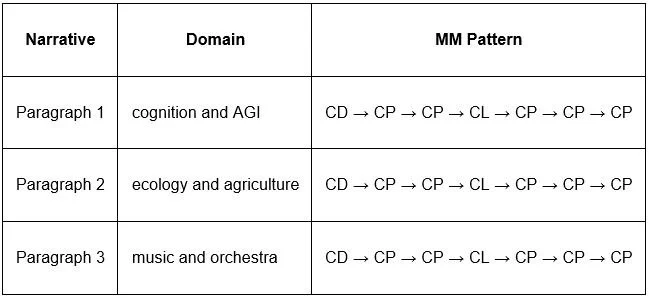
Although the vocabulary, imagery, and narrative context differ completely, all three examples generate the identical MetaMould pattern:
CD → CP → CP → CL → CP → CP → CP
This structural consistency suggests that cognition may operate through universal graph-based patterns independent of content domain. The article argues that this universality is highly significant for Artificial General Intelligence (AGI), because a truly general intelligence must recognize and process deep structural similarities across unrelated domains rather than relying only on statistical correlations between words.
The UL/MM framework therefore proposes that AGI may emerge not from increasing data scale alone, but from discovering and implementing the underlying structural language of cognition itself.
Keywords
Universal Language, MetaMould, AGI, structural cognition, graph-based intelligence, Being, Belonging, Becoming, CD, CL, CP, cognitive universality, verb ontology, structural reasoning, unsupervised learning.
1. The MetaMould Principle
The UL/MM framework proposes that verbs function as operators of cognition and can be structurally classified into three fundamental categories:
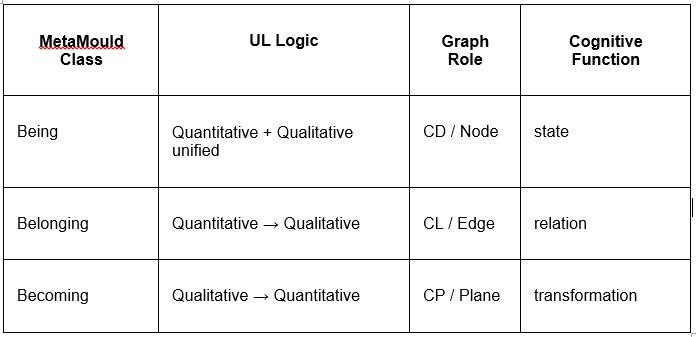
Under this framework, meaning is generated through the interaction of:
CD → CL → CP
rather than through isolated words alone.
References
Document 1 — MetaMould Verb Ontology
Document 5 — Training Schema
2. First Narrative — Cognitive Engineering and AGI
Paragraph 1
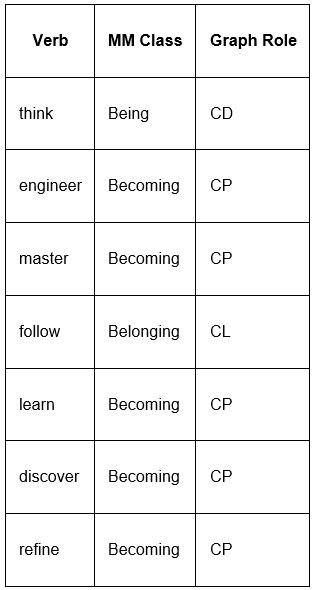
Think of UL and MM as the SpaceX of the mind—engineering a launchpad for the inner universe of human cognition. And just like SpaceX masters uncrewed flights before crewed missions, this framework follows a fundamental learning order: unsupervised learning first, then supervised learning to follow. The system first discovers hidden patterns on its own (unsupervised), then refines them with targeted guidance (supervised).
MetaMould Decomposition
MetaMould Pattern
CD → CP → CP → CL → CP → CP → CP
3. Second Narrative — Agriculture and Ecology
Paragraph 2
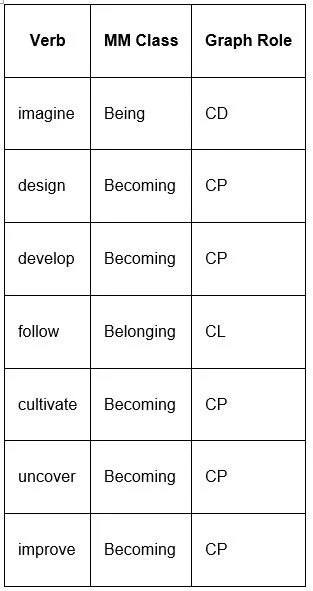
Imagine regenerative farming as the architecture of living soil—designing a foundation for the long-term renewal of ecosystems. And just as experienced farmers develop small pilot fields before expanding into full-scale cultivation, this approach follows a natural growth sequence: observation first, then guided cultivation afterward. The community first uncovers hidden patterns in climate and soil behavior on its own, then improves the harvest through careful intervention and seasonal adjustment.
MetaMould Decomposition
MetaMould Pattern
CD → CP → CP → CL → CP → CP → CP
4. Third Narrative — Music and Orchestra
Paragraph 3
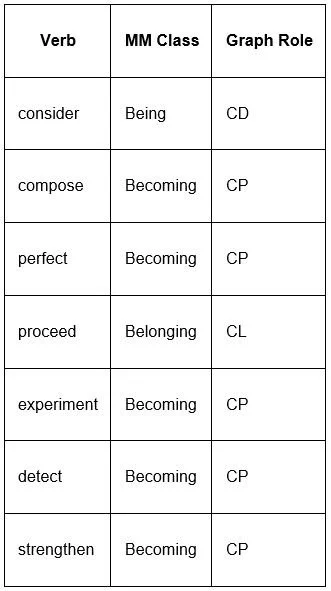
Consider a symphony orchestra as a living structure of collective emotion—composing a stage for the unfolding of musical consciousness. And just as conductors perfect rehearsals before public performances, the ensemble proceeds through a disciplined sequence: experimentation first, then coordinated execution afterward. The musicians first detect subtle harmonies through independent practice, then strengthen the performance through guided synchronization and refinement.
MetaMould Decomposition
MetaMould Pattern
CD → CP → CP → CL → CP → CP → CP
5. Structural Comparison
Although the narratives discuss entirely different domains, they preserve the same deep structural sequence.
6. Significance of the Universality
This structural equivalence is highly significant.
Traditional language systems generally treat these paragraphs as unrelated because:
vocabulary differs
semantics differ
subject domains differ
However, UL/MM identifies that all three narratives share the same underlying cognitive organization.
This suggests that cognition may operate through reusable structural templates independent of domain-specific content.
In other words:
Different narratives may emerge from the same cognitive architecture.
7. Why This Matters for AGI
A genuine AGI system must generalize across domains.
Conventional AI systems often struggle because they rely heavily on:
statistical association
token prediction
domain-specific training
The UL/MM framework proposes a different path:
Learn the structural operations of cognition itself.
If different domains share the same deep MetaMould structure, then an AGI system trained on those structures may transfer knowledge more efficiently across unrelated fields.
For example:
engineering
agriculture
music
may all be processed through the same graph-based cognitive sequence.
This provides:
interpretability
structural consistency
cross-domain reasoning
reduced dependence on massive datasets
8. MetaMould as a Universal Cognitive Architecture
The repeated pattern:
CD → CP → CP → CL → CP → CP → CP
may therefore represent a reusable cognitive architecture rather than merely a linguistic pattern.
The sequence can be interpreted as:
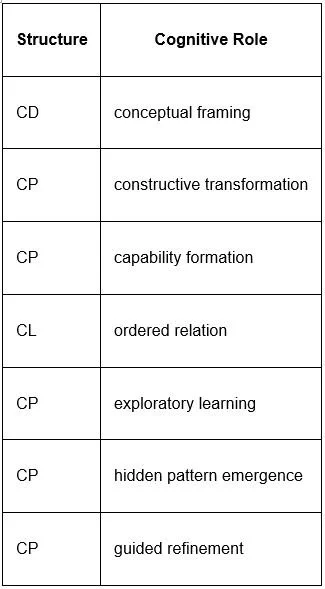
This suggests that cognition evolves through recurring structural cycles rather than isolated symbolic events.
9. Relationship to UL/MM Documents 1–5
The examples presented here directly reflect the framework established in:
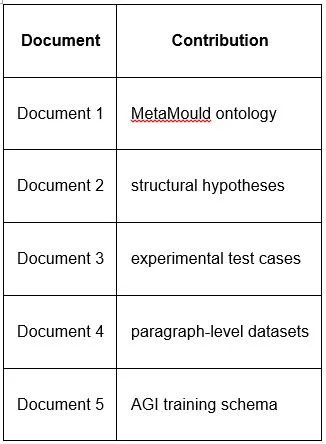
Together, these documents propose a structure-first pathway for AGI implementation.
10. Why UL/MM May Represent a Foundational Path Toward AGI
The UL/MM framework proposes that AGI should not primarily be built through:
larger datasets
larger parameter counts
increasingly complex token prediction
Instead, it suggests that AGI may emerge from:
structural cognition
graph formation
universal cognitive operations
interpretable transformation patterns
Under this approach:
language
→ structure
→ cognition
→ reasoning
→ AGI
The significance of the three narratives is therefore not literary, but structural:
Completely different domains reveal the same deep cognitive pattern.
This universality may represent one of the essential requirements for Artificial General Intelligence.
Summary
This article demonstrates that three entirely different narratives can preserve the same MetaMould structural sequence:
CD → CP → CP → CL → CP → CP → CP
Despite differences in vocabulary and domain, all three examples share the same deep cognitive organization.
This suggests that:
cognition may operate through universal graph structures
meaning may arise from structural operations rather than words alone
AGI may depend on discovering these reusable cognitive architectures
The UL/MM framework therefore proposes a structure-first model of intelligence in which:
Being defines state
Belonging defines relation
Becoming defines transformation
These are then mapped into:
CD / Node
CL / Edge
CP / Plane
The resulting system provides:
interpretable reasoning
cross-domain generalization
reusable cognitive structures
graph-based intelligence
The broader implication is that UL/MM may offer a foundational pathway toward AGI by identifying and implementing the universal structural language underlying cognition itself.
