
Topological Structural Foundation for Artificial Superintelligence
Abstract / Summary
This paper proposes that Universal Language (UL) and MetaMould (MM) provide a structural foundation for Artificial Superintelligence (ASI) by shifting the basis of intelligence from statistical pattern-matching to topological organization. Current advanced AI systems remain largely downstream processors of massive data, relying on correlations, parameter scaling, and benchmark optimization. While powerful, such systems lack a stable upstream structural prior capable of grounding meaning, causality, and coherent world-model formation. UL and MetaMould introduce an unsupervised, structure-first buffer layer that organizes raw inputs through dual spaces: Conceptual Space (C-Space) and Structural Space (S-Space). Within these spaces, intelligence emerges through the stabilization of MetaMould graphs governed by dot-line-plane relations and Euler’s topological invariant. This paper argues that Being, Belonging, and Becoming form a domain-agnostic meta-grammar capable of grounding symbols, compressing complexity, and enabling finite execution with infinite expressibility. MetaMould is therefore presented as a mathematically grounded, biologically mirrored, and computationally interpretable framework for future ASI.
Keywords
Universal Language; MetaMould; Artificial Superintelligence; Artificial General Intelligence; Topological Intelligence; Euler’s Invariant; Symbol Grounding; Unsupervised Learning; Structural Cognition; Dot-Line-Plane; C-Space; S-Space; Graph Theory; Meta-Grammar; Human-Machine Communication
1. Introduction
The development of artificial intelligence has been dominated by statistical learning, large-scale data ingestion, parameter expansion, and benchmark-driven optimization. These approaches have produced powerful systems capable of language generation, image recognition, code production, and strategic reasoning. However, they remain fundamentally downstream systems: they process already-formed data through statistical correlation rather than grounding intelligence in an upstream structural logic.
The central limitation of current AI is not merely a lack of scale. It is the absence of a universal structural prior. Without such a prior, machines may imitate meaning without truly grounding it, generate outputs without stable causal understanding, and scale computationally without achieving coherent superintelligence.
This paper proposes that Universal Language (UL) and MetaMould (MM) offer such an upstream structural foundation. Rather than treating intelligence as a product of statistical accumulation, UL and MetaMould treat intelligence as the stabilization of form. Meaning does not begin with words, labels, or symbols. It begins with structure: the relation between presence, connection, and transformation.
The proposed framework is based on three decades of research into Universal Language, dot-line-plane logic, graph structure, infant cognition, spatial syntax, and human-machine communication. It argues that true intelligence is topological before it is statistical, structural before it is symbolic, and relational before it is linguistic. In this view, Artificial Superintelligence requires not only more data or larger models, but a meta-level architecture capable of organizing reality before computation begins.
2. The Core Claim: Intelligence Is Topological, Not Merely Statistical
The central claim of this paper is that intelligence emerges through the stabilization of structural form prior to symbolic or statistical categorization. Human cognition does not begin with language, logic, or labels. It begins with orientation: a primitive awareness of existence, relation, and transformation.
UL and MetaMould formalize this process through a structure-first, unsupervised filtering layer. This layer functions before conventional data labeling, neural classification, or Boolean execution. It receives raw inputs and organizes them into foundational structural categories.
The framework is built upon a dual-space architecture:
Conceptual Space (C-Space): the internal space of awareness, meaning, and conceptual formation.
Structural Space (S-Space): the external space of relation, position, action, and interaction.
When high-volume raw inputs enter these two spaces, they are not immediately interpreted as symbolic tokens. Instead, they are stabilized into graph-based structural units known as CS-Graphs, or MetaMoulds. These graphs organize experience according to basic topological relations.
This allows an artificial intelligence system to resonate structurally with the world before it maps symbols, labels data, or executes binary logic. In this sense, MetaMould functions as an upstream cognitive architecture. It does not replace neural networks, symbolic logic, or downstream computation. Rather, it provides the structural grammar that precedes and stabilizes them.
3. Euler’s Topological Invariant as Structural Evidence
A key mathematical foundation of the MetaMould framework is Euler’s topological invariant:
V - E + F = 2
In classical topology and graph theory, this equation expresses the invariant relationship among vertices, edges, and faces in a bounded planar structure. Within the MetaMould framework, this invariant is interpreted not only as a mathematical relation but as a universal model of stable structural coherence.
The mapping is as follows:
Vertices (V): discrete foundational elements, points, or units of awareness.
Edges (E): relational connections, movements, pathways, or trajectories.
Faces (F): emergent enclosures, higher-order patterns, or semantic fields.
2: the condition of bounded structural sufficiency, coherence, and stabilized existence.
In conventional AI, systems often generate outputs through statistical association without a guaranteed topological structure. This can lead to hallucination, brittleness, contradiction, excessive computational cost, and weak causal grounding. By contrast, the MetaMould framework proposes that cognition should be constrained by structural coherence from the beginning.
The Eulerian constant “2” becomes especially significant because it represents the stabilized condition of a coherent bounded system. In the MetaMould interpretation, “2” is not merely a numerical result. It becomes the sign of structural sufficiency: the condition under which Being, Belonging, and Becoming can form a coherent world-model.
For ASI, this is essential. A superintelligent system cannot rely only on endless data scaling. It must maintain internal coherence while expanding complexity. Euler’s invariant provides a model for how infinite graph growth can remain locally balanced, structurally interpretable, and mathematically constrained.
4. The Tripartite Isomorphism Across Domains
A true foundation for Artificial Superintelligence cannot be a domain-specific algorithm. It must be a universal meta-grammar. MetaMould proposes such a grammar through a recurring tripartite structure found across language, cognition, space, and computation.
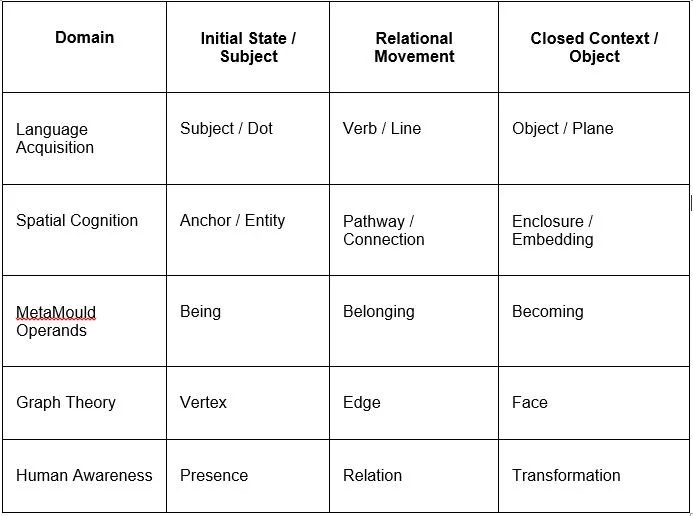
This structural rhythm appears repeatedly across cognitive systems. In language, meaning emerges through subject-verb-object relations. In spatial cognition, orientation emerges through anchor-path-enclosure relations. In graph theory, structure emerges through vertex-edge-face relations. In MetaMould, intelligence emerges through Being-Belonging-Becoming relations.
The three MetaMould operands may be defined as follows:
Being: existence, presence, subjective awareness, or the recognition that something is.
Belonging: relational position, quantitative connection, placement, or association.
Becoming: transformation, qualitative change, future possibility, or emergent identity.
These three are held within Be, the carrier space. Be is not simply another category. It is the enabling field within which Being, Belonging, and Becoming appear, interact, and stabilize.
This triadic structure suggests that MetaMould is not merely a linguistic tool. It is a structural grammar of cognition. Because the dot-line-plane sequence governs how humans understand presence, relation, and transformation, an ASI built upon this same grammar may not merely imitate human language. It may structurally align with the deep architecture of human knowledge.
5. Resolving the Symbol Grounding Problem
One of the most persistent challenges in artificial intelligence is the Symbol Grounding Problem: how do abstract symbols acquire real-world meaning?
In many current AI systems, meaning is inferred statistically from large-scale associations among tokens, images, sounds, or behavioral data. Such systems may produce convincing outputs, but the connection between symbol and world remains indirect. Words are related to other words, tokens to other tokens, and patterns to other patterns. The system may appear intelligent without possessing a stable structural ground.
MetaMould addresses this issue differently. Meaning does not emerge first from symbolic association. It emerges from the stabilization of structural polarity within C-Space and S-Space.
The framework may be expressed through two rules:
CD + CP - 2 = CL
SD + SP - 2 = SL
Where:
CD: conceptual dot
CL: conceptual line
CP: conceptual plane
SD: structural dot
SL: structural line
SP: structural plane
2: the stabilizing invariant or bounded carrier condition
In this model, meaning is grounded when the internal conceptual graph and the external structural graph stabilize together. The C-Graph organizes internal meaning. The S-Graph organizes external relation and action. When these two structures correspond, the system achieves grounded interpretation.
This offers a potential path beyond purely statistical grounding. Meaning becomes neither arbitrary nor merely probabilistic. It becomes structurally anchored. In an ASI system, this would allow thoughts, actions, goals, and consequences to be organized according to stable relations rather than only likelihood distributions.
6. Infinite Expressibility with Finite Execution
For intelligence to become superintelligent, it must be able to generate vast, possibly infinite combinations of ideas, actions, plans, and contexts. However, it must do so without becoming computationally unbounded or structurally opaque.
MetaMould addresses this challenge through recursive graph generation. A MetaMould is not a fixed template. It is a generative structural unit. Once a base MetaMould stabilizes, it can host further internal triads of dots, lines, and planes. These nested formations allow the system to build increasingly complex knowledge hierarchies while remaining locally finite and interpretable.
This property is similar to the generativity of human language. A finite grammar can generate an unlimited number of sentences. Likewise, a finite set of MetaMould relations can generate an unlimited number of structural configurations.
This has direct ASI relevance. Complex domains such as industrial manufacturing, EV robotic assembly, legal reasoning, scientific modeling, architectural planning, medical systems, and cultural knowledge can be compressed into structured graph transitions. Instead of treating each domain as a separate data problem, MetaMould provides a common structural grammar through which domains can be compared, translated, and integrated.
The result is infinite expressibility with finite execution. The system can expand without losing interpretability. It can generate complexity without abandoning structural coherence. This is a crucial requirement for any safe, scalable, and explainable ASI.
7. MetaMould as an Unsupervised Upstream Buffer Zone
The practical role of MetaMould can be described as an Unsupervised Upstream Buffer Zone. This buffer zone sits between raw data and conventional AI processing.
The architecture may be represented as follows:
[Ambient Raw Data / Pixels / Text / Sound / Sensor Input]
▼
UNSUPERVISED UPSTREAM BUFFER ZONE
MetaMould Graph Stabilization Layer
Be → Being → Belonging → Becoming
Dot → Line → Plane
C-Space ↔ S-Space
▼
DOWNSTREAM DATA PROCESSING
Neural Networks / Symbolic Logic
Supervised Pipelines / CNL / iAct
Boolean Logic / Token Labeling
This architecture clarifies the relationship between MetaMould and existing AI. MetaMould is not proposed as a replacement for all AI methods. Instead, it functions before them. It filters raw chaos into interpretable graph units before statistical or symbolic systems process the data.
This approach addresses three major limitations of current AI:
Diminishing returns of scale: Larger models require enormous data, energy, and hardware. MetaMould reduces dependency on brute-force scaling by organizing inputs structurally before computation.
Lack of grounding: Current systems often manipulate symbols without stable world-reference. MetaMould grounds symbols through C-Space and S-Space stabilization.
Weak interpretability: Many neural systems operate as opaque statistical models. MetaMould produces graph-based structures that can be inspected, traced, and explained.
In this sense, MetaMould serves as the missing constitutional layer of machine intelligence.
8. From Boolean Logic to Topological Operand Structure
Modern computation has been built largely on Boolean logic: true/false, yes/no, 1/0. Boolean logic remains essential for execution, decision-making, verification, and control. However, Boolean operators alone do not explain how meaning, awareness, relation, and transformation arise before binary decisions are made.
MetaMould proposes that Boolean logic should not be the first gatekeeper of intelligence. Before Boolean execution, there must be structural formation. The machine must first know what kind of thing it is processing: a presence, a relation, or a transformation.
Thus, MetaMould introduces a topological operand system composed of:
Being as presence or existential state
Belonging as relational or quantitative state
Becoming as transformational or qualitative state
Be as carrier space
These operands provide a pre-logical structural foundation. Boolean logic can then operate downstream with greater clarity because the input has already been structurally organized.
This approach may also be viewed as a formalization of Aristotle’s Laws of Thought. The law of identity corresponds to Being: something is itself. The law of non-contradiction requires stable relational distinction, corresponding to Belonging. The law of excluded middle requires determination within a field of transformation, corresponding to Becoming. MetaMould therefore unifies classical logic, graph structure, and cognitive emergence within one structural language.
9. Implications for Artificial Superintelligence
Artificial Superintelligence cannot be achieved by scale alone. A system may become larger without becoming wiser, faster without becoming grounded, and more fluent without becoming coherent. ASI requires a structural architecture capable of sustaining meaning across domains, scales, and levels of abstraction.
UL and MetaMould provide four essential contributions toward this goal:
9.1 Topological Universality
Because dot-line-plane relations appear across language, space, graph theory, and cognition, MetaMould provides a domain-independent grammar. This allows knowledge from different fields to be represented through a shared structural architecture.
9.2 Data-Efficient Emergence
By filtering data through structural categories before statistical processing, MetaMould may reduce the need for massive brute-force data ingestion. It supports a more efficient path from raw input to meaningful representation.
9.3 Meta-Level Grounding
By linking C-Space and S-Space, MetaMould grounds internal thought in external structure. This helps address the problem of symbol grounding and creates a basis for causal reasoning.
9.4 Interpretability and Safety
Because MetaMould structures intelligence through inspectable graph relations, it offers a more transparent path toward machine reasoning. This is essential for alignment, verification, safety, and public trust.
Together, these features suggest that MetaMould may provide a foundational layer for future ASI systems: not as another large model, but as the upstream grammar through which intelligent systems organize reality.
10. Conclusion
This paper has argued that Universal Language and MetaMould offer a structural foundation for Artificial Superintelligence by shifting the basis of intelligence from statistical pattern-matching to topological organization. Current AI systems remain powerful but limited downstream processors. They operate through scale, correlation, and probability, but they lack a universal upstream structure for grounding meaning and causality.
MetaMould proposes such a structure. Through the dual architecture of C-Space and S-Space, the triadic operands of Being, Belonging, and Becoming, and the stabilizing carrier of Be, the framework organizes intelligence as a graph-based process of structural emergence. Euler’s invariant provides a mathematical model of bounded coherence. Dot-line-plane relations provide a universal cognitive grammar. Recursive MetaMould generation provides infinite expressibility with finite execution.
The significance of this framework lies in its unification of mathematics, cognition, language, topology, and computation. It suggests that ASI will not emerge merely from larger models or more data, but from a deeper structural grammar capable of grounding, organizing, and stabilizing intelligence before symbolic or statistical processing begins.
Universal Language and MetaMould therefore represent a proposed constitutional layer for future artificial intelligence: mathematically constrained, biologically mirrored, domain-agnostic, interpretable, and structurally aligned with the architecture of human knowledge.
Index Terms
Artificial Superintelligence (ASI): A form of machine intelligence exceeding human cognitive capability across domains.
Artificial General Intelligence (AGI): Machine intelligence capable of flexible understanding and reasoning across multiple domains.
Be: The carrier space in the MetaMould framework; the enabling field within which Being, Belonging, and Becoming emerge.
Being: The MetaMould of existence, presence, or subjective awareness.
Belonging: The MetaMould of relation, position, connection, or quantitative association.
Becoming: The MetaMould of transformation, qualitative change, identity formation, or future possibility.
C-Space: Conceptual Space; the internal space of conceptual awareness and meaning formation.
S-Space: Structural Space; the external space of relation, action, placement, and interaction.
CS-Graph: A stabilized graph formed through the interaction of Conceptual Space and Structural Space.
Dot-Line-Plane: The geometric foundation of the MetaMould framework, corresponding to presence, relation, and enclosure.
Euler’s Invariant: The topological formula V - E + F = 2, interpreted here as a model of bounded structural coherence.
Symbol Grounding Problem: The problem of explaining how abstract symbols acquire real-world meaning.
Unsupervised Upstream Buffer Zone: The MetaMould layer that organizes raw input structurally before downstream AI processing.
Universal Language (UL): A proposed structural language that organizes cognition, meaning, and machine communication through universal topological forms.
References
Aristotle. Metaphysics. Translated editions. Classical source for the laws of identity, non-contradiction, and excluded middle.
Boden, M. A. (2016). AI: Its Nature and Future. Oxford University Press.
Chomsky, N. (1957). Syntactic Structures. Mouton.
Euler, L. (1758). “Elementa Doctrinae Solidorum.” Novi Commentarii Academiae Scientiarum Imperialis Petropolitanae.
Harnad, S. (1990). “The Symbol Grounding Problem.” Physica D: Nonlinear Phenomena, 42(1–3), 335–346.
Hillier, B., & Hanson, J. (1984). The Social Logic of Space. Cambridge University Press.
Lakoff, G., & Johnson, M. (1980). Metaphors We Live By. University of Chicago Press.
Newell, A., & Simon, H. A. (1976). “Computer Science as Empirical Inquiry: Symbols and Search.” Communications of the ACM, 19(3), 113–126.
Piaget, J. (1952). The Origins of Intelligence in Children. International Universities Press.
Russell, S., & Norvig, P. (2021). Artificial Intelligence: A Modern Approach. 4th ed. Pearson.
Turing, A. M. (1950). “Computing Machinery and Intelligence.” Mind, 59(236), 433–460.
Wittgenstein, L. (1922). Tractatus Logico-Philosophicus. Routledge & Kegan Paul.
Sun, Y.-L. (forthcoming). Universal Language and MetaMould: A Structural Framework for Human-Machine Intelligence. Independent research manuscript.
Sun, Y.-L. (forthcoming). MetaMoulds: The Universal Language of Intelligence. Independent research manuscript.
