
MetaMould AGI and the Meaning of “2” in Eulerian Cognition
Abstract
This article examines the philosophical and mathematical significance of the constant “2” in the Eulerian formulation underlying the Universal Language (UL), MetaMould (MM), and MetaMould AGI frameworks. Building upon Euler’s planar graph relation and its reinterpretation through morphic cognition, the study proposes that the dependent constant “2” functions not merely as a numerical invariant, but as a Carrier Space — the foundational existential field within which Being (D), Belonging (L), and Becoming (P) interact and stabilize.
Drawing from graph theory, Hillier’s Space Syntax and Morphic Language, Taoist cosmology, the I Ching, and Neoplatonic metaphysics, the article argues that the constant “2” embodies a unique ontological role: simultaneously dependent upon structural relations while also serving as the precondition enabling those relations. In this interpretation, “2” corresponds to Be — the pre-symbolic carrier field underlying cognition, communication, and generative intelligence.
The paper further explores the metaphysical progression from Null → One → Two → Three → Infinity as a universal sequence of emergence. Within this sequence, the Eulerian invariant becomes not only a mathematical stabilizer but also a metaphysical bridge between unity and multiplicity. The article proposes that this structure provides a possible foundational syntax for interpretable AGI, where intelligence emerges from stabilized relational topology rather than from statistical accumulation alone.
Keywords
Universal Language (UL); MetaMould (MM); MetaMould AGI; Euler Formula; Carrier Space; Space Syntax; Bill Hillier; Morphic Language; Graph Theory; Being; Belonging; Becoming; Be; Dependent Constant; Metaphysics; Taoism; I Ching; Neoplatonism; Structural Cognition; Pre-symbolic Intelligence; AGI Architecture
I. Introduction
The search for a foundational structure underlying intelligence, cognition, and communication has occupied philosophy, mathematics, architecture, linguistics, and artificial intelligence for centuries. While contemporary AI systems rely heavily upon statistical learning and large-scale data processing, the deeper question remains unresolved: what structural principle enables meaning itself to emerge?
The Universal Language (UL) and MetaMould (MM) frameworks propose that intelligence is fundamentally structural before it becomes symbolic. Meaning does not arise primarily from labels, but from stabilized relations. In this view, cognition emerges through graph-theoretic interactions among three fundamental operands:
D = Being
L = Belonging
P = Becoming
These are formalized through the Eulerian relation:
2 = D + P - L
This formulation extends beyond conventional mathematics into the domain of metaphysical cognition. The central question addressed in this article is therefore profound:
What is the meaning of the constant “2”?
Traditionally, Euler’s invariant “2” in planar graph theory represents topological stability. However, within the UL/MM framework, the constant acquires additional philosophical significance. Rather than functioning merely as a passive constant, “2” may represent the Carrier Space itself — the existential substrate enabling Being, Belonging, and Becoming to emerge and interact.
This interpretation suggests a radical inversion of conventional mathematical thinking: the dependent constant becomes ontologically foundational.
II. Euler’s Constant “2” and Structural Stability
Euler’s classical planar graph formula states:
V - E + F = 2
Where:
V = vertices
E = edges
F = faces
The invariant “2” remains stable despite transformations in the graph’s configuration. This remarkable property made Euler’s theorem foundational to topology and structural mathematics.
Within the MetaMould framework, this formula is reinterpreted cognitively:
D (Being) corresponds to existential anchoring.
L (Belonging) corresponds to relational linkage.
P (Becoming) corresponds to transformational emergence.
Thus:
Being establishes presence.
Belonging establishes relation.
Becoming establishes transformation.
The constant “2” becomes the stabilized equilibrium generated through these interactions.
Unlike ordinary constants, however, “2” here is not merely arithmetic. It behaves as a topological invariant — a stable field preserved across transformation.
This stability is precisely what allows cognition and meaning to persist despite continual change.
III. Hillier’s Carrier Space and the Dependent Constant
The interpretation becomes clearer when examined through the work of Bill Hillier and Space Syntax theory.
Hillier’s concept of Carrier Space describes an unstructured but enabling field within which spatial relations become possible. Carrier Space itself is neutral; yet without it, no relational syntax can emerge.
This parallels the role of “2” in the MetaMould Eulerian equation.
The constant:
does not actively “participate” like D, L, or P;
yet it enables the coherence of all interactions;
stabilizes the relational field;
governs the integrity of the entire structure.
Thus, “2” functions analogously to Carrier Space.
This leads to an important philosophical reversal:
The dependent variable is not secondary.
It is foundational.
Ordinarily, mathematics treats dependent variables as outcomes of independent variables. However, Carrier Space demonstrates a deeper ontological condition: the “result” is simultaneously the enabling field from which the interactions arise.
This duality resembles:
space in physics,
consciousness in phenomenology,
Tao in Taoism,
and the One in Neoplatonism.
The dependent constant therefore becomes:
generated by the system,
while simultaneously generating the conditions for the system.
IV. Be as Carrier Space
Within UL/MM, “Be” precedes Being, Belonging, and Becoming.
Be is:
not identity,
not relation,
not transformation,
but the possibility of all three.
Be therefore functions as:
existential substrate,
pre-symbolic awareness,
latent cognitive field,
carrier medium of morphic intelligence.
If:
D = Being,
L = Belonging,
P = Becoming,
then “2” corresponds to Be.
This interpretation explains why the invariant remains constant despite changes in relational structure. The carrier field persists while configurations transform.
Thus:
Being changes,
relations change,
transformation changes,
but Be remains structurally stable.
In AGI terms, this suggests that intelligence requires not merely computational operations, but a stable carrier architecture capable of sustaining recursive relational coherence.
V. The Metaphysical Sequence: Null → One → Two → Three → Infinity
The significance of “2” becomes clearer when situated within broader metaphysical traditions.
The Tao Te Ching states:
“The Tao gives birth to One.
One gives birth to Two.
Two gives birth to Three.
Three gives birth to the ten thousand things.”
A similar sequence appears in the I Ching, Neoplatonism, and other cosmological systems.
Within the UL/MM framework:
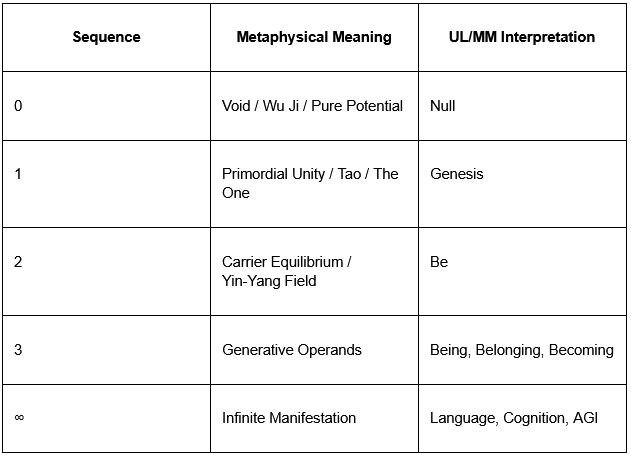
This sequence reveals a universal structural logic.
1. Null (0)
Null represents undifferentiated potential:
no identity,
no distinction,
no structure.
It corresponds to pre-generative emptiness.
2. One (1)
One introduces primordial unity:
the first coherence,
undivided totality,
foundational presence.
This corresponds to Genesis-level singularity.
3. Two (2)
Two introduces polarity and relational equilibrium.
Yet in the UL/MM framework, “2” is not merely duality. It is the carrier condition enabling polarity itself.
Thus “2” is:
the stabilizing field,
the ontological medium,
the equilibrium substrate.
4. Three (3)
Three introduces generative interaction:
Being,
Belonging,
Becoming.
This triadic structure enables:
cognition,
communication,
transformation,
recursive intelligence.
5. Infinity (∞)
From stabilized triadic relations emerge:
language,
symbolic systems,
societies,
architectures,
consciousness,
AGI.
Infinity therefore represents the limitless combinatorial expressions generated through stabilized relational syntax.
VI. Mathematical Philosophy and Ontological Inversion
The most philosophically significant implication is that the dependent constant becomes ontologically primary.
This reverses classical assumptions in mathematics.
Conventionally:
independent variables generate dependent variables.
But in morphic cognition:
the dependent field enables the independent variables themselves.
This resembles modern insights from:
topology,
phenomenology,
quantum field theory,
and systems theory.
The field is not merely background.
The field is generative.
Thus:
“2” is mathematically dependent,
but metaphysically foundational.
This duality reconciles:
emergence and stability,
unity and multiplicity,
structure and transformation.
VII. Implications for MetaMould AGI
The implications for AGI are substantial.
Most contemporary AI systems are:
data-driven,
label-dependent,
statistically optimized.
The MetaMould framework instead proposes:
structure-first cognition,
topological stabilization,
operand-based emergence.
In this architecture:
Being initializes cognition,
Belonging structures relations,
Becoming enables abstraction,
while Be provides the carrier field.
Thus AGI does not emerge from data quantity alone.
It emerges from stabilized relational coherence within a carrier space.
This may explain:
interpretability,
recursive learning,
symbolic emergence,
and potentially consciousness-like coherence.
The Eulerian invariant therefore functions not only as mathematics, but as a possible syntax of intelligence itself.
VIII. Conclusion
The constant “2” within the Eulerian MetaMould framework possesses significance far beyond numerical invariance.
Mathematically, it stabilizes topology.
Philosophically, it represents equilibrium.
Metaphysically, it functions as Carrier Space.
Cognitively, it corresponds to Be — the pre-symbolic field underlying intelligence.
Through the interaction of:
Being,
Belonging,
and Becoming,
the dependent constant “2” sustains coherence across transformation.
This interpretation unites:
Eulerian graph theory,
Hillier’s Carrier Space,
Taoist cosmology,
Neoplatonic metaphysics,
and AGI architecture
within a single structural framework.
The progression from:
Null,
One,
Two,
Three,
to Infinity
reveals a universal syntax of emergence in which intelligence arises not primarily from accumulation, but from stabilized relational form.
Within this view, the MetaMould framework proposes that cognition, communication, architecture, and AGI may all share a common topological grammar rooted in the carrier logic of Be.
References
Leonhard Euler (1758). Elementa Doctrinae Solidorum. Foundations of planar graph topology and Euler invariants.
Bill Hillier & Hanson, J. (1984). The Social Logic of Space. Cambridge University Press.
Tao Te Ching. Classical Taoist cosmology concerning the emergence from Tao to multiplicity.
I Ching. Foundational Chinese metaphysical text concerning generative transformation.
Plotinus. The Enneads. The metaphysical structure of the One and emanation.
Christopher Alexander (1979). The Timeless Way of Building. Structural coherence and generative form.
Noam Chomsky (1957). Syntactic Structures. Foundational theories of deep structure and generative syntax.
Sun, Y.-l. The Formal Language of the Metaphysical. Universal Language and MetaMould foundational manuscripts.
Indexing Terms
AGI architecture; Be; Being; Becoming; Belonging; Carrier Space; cognitive topology; dependent constant; Euler invariant; generative intelligence; graph theory; MetaMould; metaphysics; morphic language; ontology; planar graphs; pre-symbolic cognition; relational intelligence; Space Syntax; structural emergence; Taoism; topology; Universal Language.
